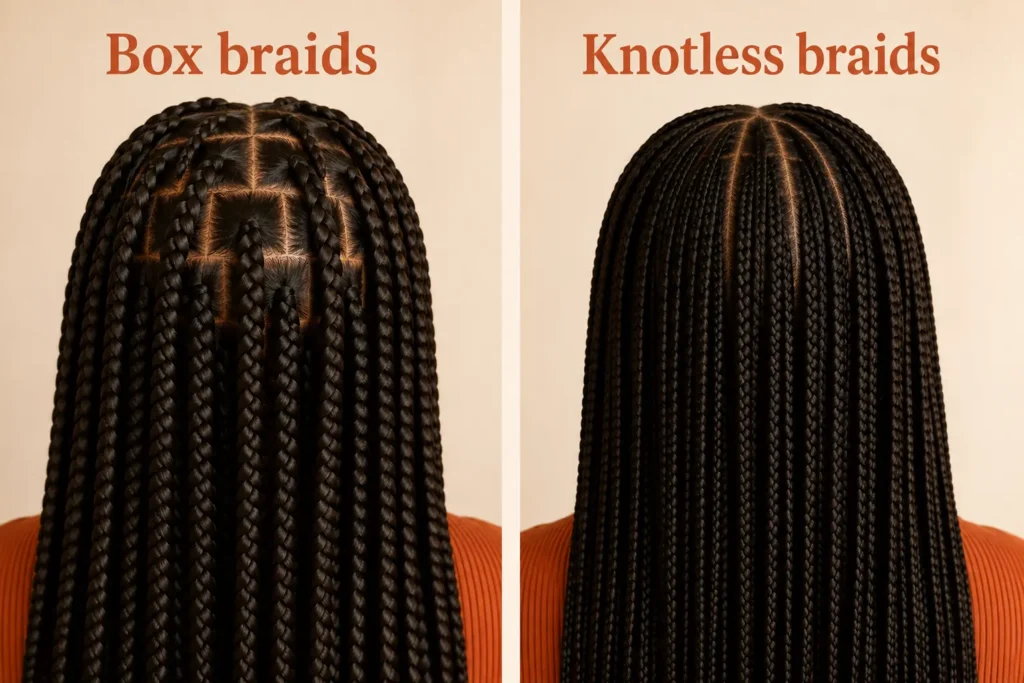
Short version: they end up looking almost the same, but they start differently. Box braids begin with a small knot at the root; knotless braids are fed in gradually so there is no knot. That one change is what makes knotless sit flatter, pull less on your edges, and usually cost a little more.
If you have been staring at two sets of photos that look identical and wondering why one costs more, this post explain what actually separates them, and how to pick the right one for your hair.
What box braids are
Box braids are individual three-strand braids, sectioned off in neat squares across the head, hence the name. The braider ties the extension hair onto your own with a small knot at the root, then braids down to the end.
It is the classic method, it holds well, and because the knot is quick to make, it is usually the faster and cheaper of the two.
What knotless braids are
Knotless braids skip the knot. The braider starts with a little of your own hair and feeds the extension in bit by bit as they go down, so the braid builds up gradually from the root. The result is a braid with no bump at the base that lies flat against the scalp.
It is a newer method and it takes longer, which is why it costs a touch more.
The difference that matters: the root
Everything else follows from how each braid starts.
A box braid’s knot gives it a firm anchor, but it also creates a small point of tension right at your scalp, and a visible bump if the braids are parted.
Whereas a knotless braid has no anchor point, so the weight is spread along the braid instead of pulled tight at one spot.
Same style, gentler start.
| What you’re comparing | Box braids | Knotless braids |
|---|---|---|
| The root | Small knot, slight bump | No knot, sits flat |
| Tension on edges | More, concentrated at the knot | Less, spread along the braid |
| Comfort day one | Can feel tight at first | Usually more comfortable |
| Install time | Quicker | Longer |
| Typical cost | A little lower | Small add-on over box |
| The finished look | Very similar | Very similar, flatter roots |
A general comparison. How each turns out depends on the braider, your hair and the size and length you choose.
Which is gentler on your edges
Knotless, in most cases. Because there is no knot pulling at the root, there is less tension on your edges and hairline, which is where braid damage usually shows up first.
If your edges are fine, if braids have given you headaches or little bumps before, or if you wear protective styles back to back, knotless is the safer pick. But tension comes down to the braider’s hand as much as the method: a braider who installs box braids too tight can still cause problems, and a gentle braider can do a comfortable knotted set.
The cost difference
Knotless usually costs a bit more than box braids at the same size and length, because feeding the hair in gradually takes longer and box braids are priced mostly on time. Expect a modest add-on rather than a different league of price.
Both climb the same way in terms of price. Smaller braids and longer lengths cost more, whichever method you choose.
We break the numbers down in the full guides: box braid costs and knotless braid costs.
Which lasts longer
Box braids often hold a touch longer, because the knot keeps the base tight and the braids stay put. Knotless can start to slip or frizz at the root a little sooner, though good installation and decent aftercare close most of that gap.
For both, six to eight weeks is a sensible window before it starts looking past its best, and neither should be left in so long that your natural hair mats at the roots.
So which should you choose?
Go knotless if comfort and your edges are the priority, if you want the flattest finish, and you do not mind paying a little more or sitting a little longer.
Opt for box braids if you want a firmer, longer-lasting set for less, your edges are strong, and you are happy with the classic look.
Neither is better outright, they suit different hair and different budgets.
Whichever you pick, the braider matters more than the method. A careful braider working at the right tension is what protects your hair, so choose on skill and photos first, style second.
Find a braider who does knotless or box braids
Once you know which you want, the next step is comparing braiders near you. Browse by style and city below.
Frequently asked questions
- Do knotless and box braids look different?
- Barely, once they are in. The main visible difference is at the root: knotless braids lie flat with no bump, while box braids have a small knot at the base. Down the length, most people cannot tell them apart.
- Are knotless braids better for your hair?
- Usually gentler, yes. With no knot pulling at the root, there is less tension on your edges, which is where braid damage tends to start. Tension still depends on the braider, so a gentle hand matters as much as the method.
- Why do knotless braids cost more?
- They take longer to install. Feeding the hair in gradually is slower than tying a knot and braiding down, and braids are priced mostly on time. The difference is usually a modest add-on, not a big jump.
- Which lasts longer, knotless or box braids?
- Box braids often hold slightly longer because the knot keeps the base tight. Knotless can frizz at the root a little sooner, though good aftercare narrows the gap. Six to eight weeks is a sensible wear time for both.
- Are box braids more painful than knotless?
- They can feel tighter at first because of the tension at the knot. Knotless tends to be more comfortable on day one. Neither should be painful; if a set genuinely hurts, it is too tight and worth flagging to your braider.