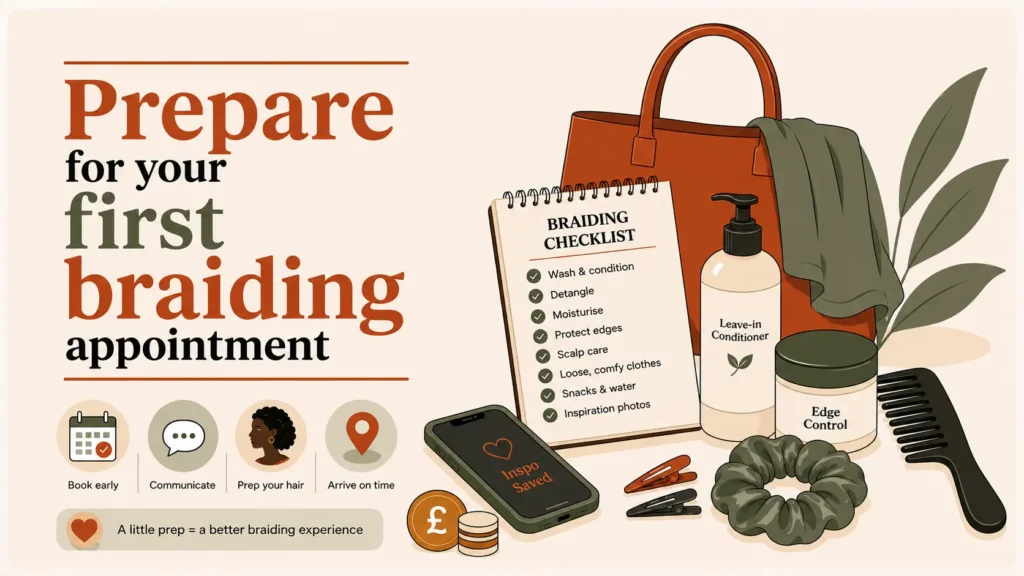
Most of what makes a braiding appointment go well happens before you sit down. Hair that has been washed, stretched and properly detangled braids faster, sits better and hurts less. Hair that turns up damp, tangled or still full of last month’s gel makes a long day longer for both of you.
This post tells you what to sort out, in the order you need to do it, from the week before to the moment you walk in.
Before you book, get three things straight
Ask about all three of these things when you send your first message. Getting a surprise once you are in the chair is how appointments turn awkward.
- Whether the hair is included. Plenty of UK braiders quote for their time only and expect you to bring your own packs. Others supply everything. The difference can easily range from £20 to £60. So, a quote without this answer is not really a quote.
- How long it will take. You need to know whether you are booking three hours or eight so you can plan food, childcare and getting home. Ask for a realistic figure, not a best case.
- The deposit and cancellation terms. Most braiders take a deposit to hold the slot. Find out how much, whether it comes off the final price, and what happens if you need to move the date.
Buying your hair
If you are supplying hair yourself, ask your braider exactly what to buy before you go shopping. Get the brand, the type and, most importantly, the number of packs.
Guessing here is the single most common reason an appointment stalls halfway through, and running to a shop mid-braid with half a head done is nobody’s idea of a good afternoon.
As a rough guide, a medium-sized set to that runs down to the middle of your back usually takes five to eight packs of synthetic braiding hair, while longer or finer braids take more.
Buy an extra pack. If it goes unused you will use it next time, and it costs a lot less than the disruption of running short.
Pre-stretched hair is well worth the small extra cost. It comes ready-tapered, so your braider spends less time pulling the ends out and the finished braids look neater.
If your scalp has reacted to synthetic hair before, say so when you ask, and look at the itch-free options.
Washing and prepping your hair
Wash it, and wash it properly
Turn up with clean hair unless your braider has specifically told you otherwise. Clarify if you have been using a lot of product, then condition. Braids sit on your scalp for weeks, and starting on build-up means starting with an itch you cannot reach.
Make sure it is completely dry
This tip matters more than people expect. Damp hair braided tight takes a long time to dry underneath, and damp hair trapped against the scalp is how you end up with a smell after a fortnight. Give yourself a full day between washing and your appointment if you can.
Stretch it
Blow-dried, banded or threaded, the goal is the same: hair that is stretched out rather than shrunk up. Stretched hair is quicker to part and quicker to braid, and quicker braiding means less time in the chair and often a better price if your braider charges by time.
If you would rather not use heat, band your hair overnight or use African threading.
De-tangle it thoroughly
Work through your hair in sections until a comb runs clean from root to tip to de-tangle it. Any knot you leave in becomes a knot your braider has to fight through, section by section, and that is where a lot of unnecessary pulling comes from.
What to skip
Go easy on heavy oils, butters and gels on the day of your appointment. A slippery scalp makes clean parting harder and a greasy root makes braids slide. Light moisturiser is fine, a full oil treatment the night before is not.
Trim it if it needs trimming
If your ends are due a trim, do it before your braids go in rather than after they come out. Split ends will not improve under braids, and you will get a cleaner finish. It also means the length you see when they come out is length you actually want to keep.
What to bring on the day
The list is short, but each thing on it saves a small problem later.
- Your hair packs, if you are supplying them, plus the spare
- A phone charger or power bank, since you are going to be there a while
- Headphones, a book or something downloaded to watch
- Food and a drink, unless you have checked there is somewhere nearby
- A photo of exactly the style you want, saved offline in case signal is poor
- Cash or your card, and confirmation of how they want to be paid
- A satin scarf or bonnet for the journey home
What to wear
Wear something comfortable you can sit still in for hours, with a neckline that does not fight against the work being done. A vest top or a wide, low neck is easier than a hoodie or a polo neck, and it means you are not pulling clothing over finished braids at the end.
If you want to wear a jumper, bring one you can drape over your shoulders rather than pull on over your head.
How long you will actually be there
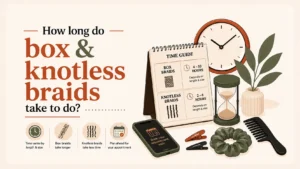
Braids are priced and timed on how many there are, so size drives everything. Jumbo braids can be done in two to four hours. A medium set to mid-back is commonly four to seven. While fine braids can run eight hours or more, sometimes across two days.
Knotless takes longer than knotted at the same size because the hair is fed in gradually.
Clear the whole day rather than booking something for the evening. We go through this properly in how long box and knotless braids take to do.
What to say when you sit down
Two things, and say them at the start rather than an hour in.
First, show the photo and agree the size, length and parting before any hair goes in. Words like “medium” mean different things to different people, and a picture clarifies what you are hoping for in seconds.
Second, speak up about tension. If a section feels tight, say so immediately. A good braider would far rather loosen one braid at the start than have you sitting through six hours in pain, and tension at the hairline is where damage begins.
Braids should feel snug, not sore. If your eyes are watering, that is not you being dramatic, it is too tight.
The first night
Do not be alarmed if your scalp feels tender for the first day or so, especially around the edges and the nape. A warm shower, letting your hair down out of any style, and a night’s sleep usually settles it. Tie your braids up loosely in a satin scarf rather than in a tight bun.
If it still hurts after two days, or you can see small bumps along your hairline, that is worth acting on rather than waiting out. Get in touch with your braider, and take a couple of the tightest braids down if you need to.
Find a braider near you
When you are ready to book, compare braiders by style and area.
- Braiders across the UK
- Knotless braids (all areas)
- Box braids (all areas)
- Cornrows (all areas)
- Knotless braiders in London
- Box braiders in Birmingham
- Box braiders in Manchester
Frequently asked questions
- Should I wash my hair before getting braids?
- Yes, and dry it fully. Clean, dry, stretched hair braids faster and stays fresher for longer under the braids. Wash the day before rather than the morning of, so there is no damp left at the roots.
- How many packs of braiding hair do I need?
- A medium set to mid-back usually takes five to eight packs, more for smaller or longer braids. Ask your braider for their number before you buy, and get one spare pack. Running short mid-appointment is the most common thing that derails a booking.
- Should I blow-dry my hair before braiding?
- Stretched hair is what matters, and blow-drying is the quickest way to get there. If you would rather avoid heat, band your hair in sections overnight or use African threading. Either way, it should not be shrunk up when you arrive.
- Can I get braids on dirty hair?
- You can, but it is a poor start. Product build-up and oil on the scalp mean an itch that sets in within days and a scalp you cannot properly clean for weeks. Some braiders will turn you away, and fairly.
- What should I bring to a braiding appointment?
- Your hair packs if you are supplying them, food and a drink, a charger, something to watch or listen to, a photo of the style, your payment method and a satin scarf for the way home.
- How long does a first braiding appointment take?
- Anywhere from two hours for jumbo braids to eight or more for small ones, with four to seven hours typical for a medium set. Ask your braider for a realistic estimate and clear the day rather than booking something afterwards.
- Is it normal for braids to hurt at first?
- Some tenderness in the first day is common, particularly at the edges and nape. Real pain is not normal and means the braids are too tight. Say something during the appointment rather than after, when it is easy to fix.