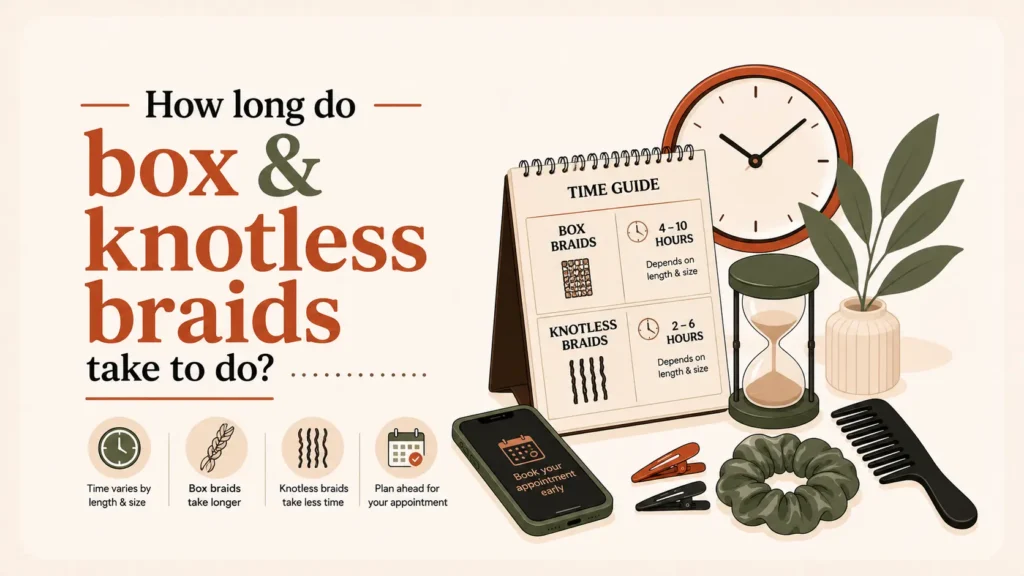
Braids can take anywhere from two hours to two days to do. That is not a useful answer on its own, so this post explores the detail: what affects how long it takes, what a realistic estimate looks like for the set you are booking, and how to plan a day around it without ending up somewhere you cannot leave.
Time matters beyond your diary, too. Braids are priced mostly on hours, so knowing the timing tells you whether a quote makes sense.
Typical times
These times assume one experienced braider, working alone, on hair that arrives clean, dry, stretched and de-tangled.
| Size and length | Box braids | Knotless |
|---|---|---|
| Jumbo, shoulder | 2–3 hours | 2.5–4 hours |
| Large, mid-back | 3–4 hours | 3.5–5 hours |
| Medium, mid-back | 4–6 hours | 5–7 hours |
| Medium, waist | 5–7 hours | 6–8 hours |
| Small, mid-back | 6–8 hours | 7–10 hours |
| Small or micro, waist | 8–12 hours | 10–16 hours, often two days |
Indicative for one braider working alone. Add time if your hair needs washing, stretching or an old set taking down on the day.
Why knotless takes longer
A knotted braid starts with a quick tie at the root and then it is straightforward braiding down the length of your hair. A knotless braid starts with your own hair and has extensions fed in gradually over the first inch or two, which is fiddly work repeated a hundred or more times.
The difference in time is around 20 to 30 per cent at the same size and length. So, on a medium set that can work out to roughly an hour extra. On fine braids, that can add up to three. That extra time is exactly what you are paying the knotless premium for, and it is also what gives you the flatter root and the lower tension.
What else changes the time
How you turn up
The biggest variable you control. Hair that arrives washed, fully dry, stretched and properly de-tangled can save an hour or more against hair that needs work first.
Some braiders charge for washing and stretching, others simply build it into the day, but either way it is time.
Taking down an old set on the day is the other big one. Budget one to three hours for that on top, and expect to be charged for it. Doing it yourself the night before is the single easiest way to shorten your appointment and reduce your costs.
Your hair itself
Very thick or very long natural hair means more sections and more to control in each one. Very short hair can also slow things down, because there is less to grip. Neither is a problem, but both are honest reasons an estimate can vary.
The braider
Speed of braiding also varies a lot between individuals, and it is not a straightforward quality signal. Someone who has braided full time for fifteen years can be genuinely braid faster at the same tension and neatness. Someone rushing to fit three clients into a day is a different thing altogether.
Breaks
A seven-hour appointment includes breaks, for both of you. Braiding is physical work and nobody does their best parting in hour eight without stopping. Factor 30 to 45 minutes of breaks into any long booking.
Two braiders instead of one
Plenty of UK braiders work in pairs on larger sets, and it nearly halves the time. A fine waist-length set that would be a twelve-hour solo day becomes a six or seven hour one.
Having a duo usually costs more, because you are paying for two people’s time, though not always double. If you cannot sit for ten hours, or you have children to get back to, it is often worth asking whether they offer it. Also, the finish can vary slightly between two pairs of hands, so ask to see work they have done together.
Planning the day
- Ask for a realistic estimate, not a best case. Give the style, size, length, method and a photo, and ask what time they expect to finish rather than how long it takes.
- Clear the whole day. Do not book anything for the evening on a medium or small set. Overruns are normal and you do not want to be watching a clock.
- Sort food before you go. Bring lunch and a drink. Not every braider works somewhere with a shop round the corner, and a six-hour appointment on an empty stomach is miserable.
- Take down your old set yourself the night before. Saves one to three hours and usually saves money too.
- Charge your phone and download something. A power bank and offline downloads beat relying on someone else’s signal and sockets.
- Check the finish time against your transport. If the estimate is eight hours from a 10am start, work out what a two-hour overrun does to your last train.
If your braiding appointment is running longer than expected
Overruns happen, and most are nobody’s fault. If you are approaching a hard deadline, say so early rather than at the point where you have to leave. A braider with two hours’ notice can speed up the back sections or agree to finish another day. A braider told at the last minute cannot.
What you should not do is ask them to rush the whole head. Fast braiding means tight braiding, and a couple of hours saved is not worth a month of sore edges.
If you genuinely have to leave with the work unfinished, agree there and then what happens: when you come back, whether it costs more, and what you pay now.
Fast is not the same as good
It is tempting to shop on speed, especially for fine braids. Be careful making that choice. The most common way a braider works faster than the times above is by pulling tighter, and tension at the root is the main cause of the edge damage people blame on braids in general.
A braider who quotes five hours for a fine waist-length set is telling you something, and it is not that they are brilliant. Equally, an unusually slow braider is not automatically gentle. Judge the work, look at photos of roots and partings, and treat the time estimate as planning information rather than a score.
Find a braider near you
Braider profiles list the styles they do and how to get in touch, so you can ask about timings before you commit.
- Knotless braids (all areas)
- Box braids (all areas)
- Knotless braiders in London
- Box braiders in Manchester
- Braiders across the UK
Frequently asked questions
- How long do knotless braids take?
- Around five to seven hours for a medium set to mid-back, two and a half to four for jumbo, and seven to ten for small braids. Micro braids at waist length can run to sixteen hours and are often split across two days.
- How long do box braids take?
- Roughly 20 to 30 per cent quicker than knotless at the same size and length. Four to six hours for a medium mid-back set, two to three for jumbo, and six to eight for small.
- Why do knotless braids take longer than box braids?
- The extension hair is fed in gradually over the first inch or two of each braid rather than tied on with a knot. That is fiddly work repeated a hundred or more times, and it is what you pay the knotless premium for.
- Can braids be done in one day?
- Almost always, yes. The exception is micro or very small braids at long lengths, which some braiders split across two days rather than working a sixteen-hour shift. Ask when you book.
- Can two braiders do my hair at once?
- Many UK braiders work in pairs on larger sets and it nearly halves the time. It usually costs more, though not always double. Ask to see work the two of them have done together.
- How can I make my braiding appointment quicker?
- Turn up with hair washed, fully dry, stretched and detangled, and take down any old set yourself the night before. Between them those can save two hours or more, and often money too.
- What happens if my braid appointment overruns?
- It is common. Flag any hard deadline early rather than at the last minute, so your braider can adjust. Do not ask them to rush the whole head, because faster usually means tighter.